Monday, 2nd February 2026
If the last 24 hours have shown anything, it is that peace remains a brittle concept. Across continents, governments strained to control narratives of strength against a backdrop of division, tragedy and uneasy alliances. From the corridors of Washington to the shattered homes of Gaza, the world seemed once again suspended between endurance and upheaval.
Washington in Convulsion
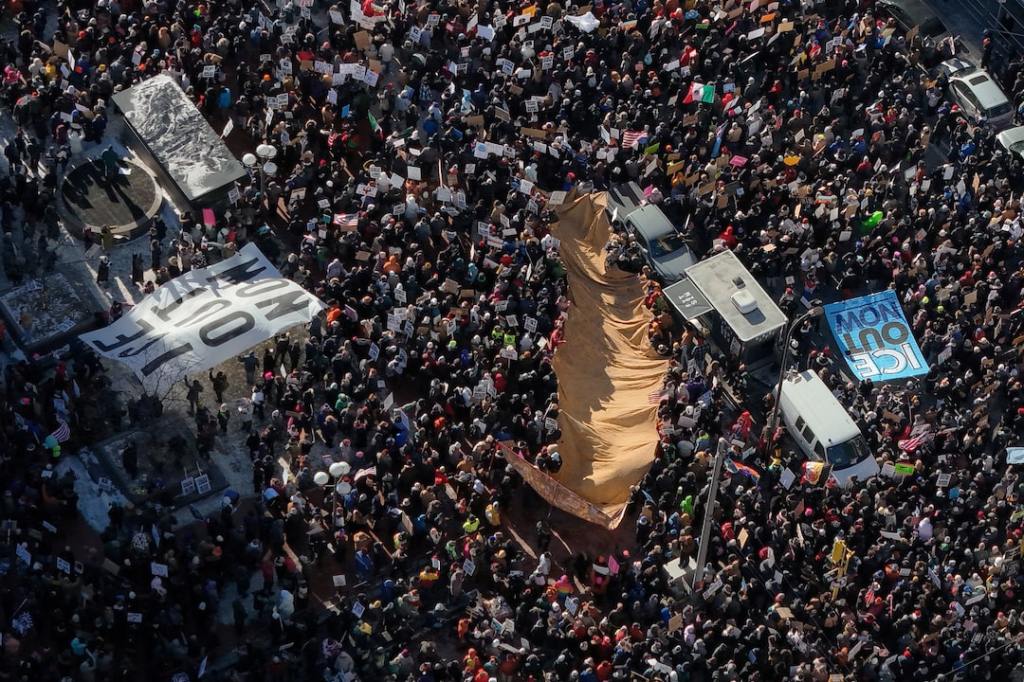
In the United States, the Trump administration’s crackdown on immigration sparked fresh fury after reports emerged of civilian deaths during an ICE operation in Minneapolis. The killings, described by rights groups as “state‑sanctioned terror,” provoked nationwide condemnation and renewed protests across major cities. In Minneapolis itself, local community leaders vowed to resist what they called “the criminalisation of survival,” even as federal agents promised to “restore order.”
In a briefing covered by The Guardian, President Trump’s aides defended the raids as part of the administration’s wider “mass deportation campaign” — one that federal courts have begun to challenge. A ruling late Sunday temporarily curbed indefinite detentions, marking a legal blow to the Department of Homeland Security’s new internal directive.
Meanwhile, the political temperature in Washington rose sharply over the administration’s closure of the Kennedy Center for a planned two‑year refurbishment. Critics accused the White House of using “construction” as cover to silence cultural dissent, while Trump’s team insisted the renovation was “long overdue.” Within a capital already polarised by accusations of media censorship and “tech baron propaganda,” as one Guardian column described it, the arts have now become another frontier of America’s rhetorical war.
Middle East: A War Without End
Across the Atlantic, the wars that never quite end consumed their latest victims. At least five Palestinians were killed in a new wave of Israeli strikes overnight, raising the war’s death toll to 71,800. Among them was a three‑year‑old boy. The Israeli Defence Forces said they were targeting militants who had approached troops near the Gaza “Yellow Line,” describing the action as “defensive and necessary.”
The cycle of violence continued further north. Israel confirmed that its military had also struck Hezbollah targets in southern Lebanon, claiming to have killed a senior militant in a precision strike. Lebanese media condemned what it called an “open‑ended campaign of intimidation.”
Meanwhile in Syria, signs of a new yet fragile modus vivendi emerged. As part of a tentative ceasefire deal, the Kurdish‑led Syrian Democratic Forces (SDF) formally handed over control of al‑Hasakah to the Syrian transitional government, The move represents a rare moment of institutional cooperation after years of conflict, though observers warn it might simply formalise the uneasy partition of northern Syria rather than resolve it.
Europe: The Edges of Unity
Europe spent the day oscillating between crisis management and fatigue. In Russia, tragedy overshadowed politics after a bus collided with a lorry in Krasnoyarsk, killing five children and injuring six others. Hours later, a DA40 light aircraft crashed near Orsk, claiming three more lives. Regional governors declared days of mourning, and national media called for renewed scrutiny of transport safety standards that have deteriorated sharply in the post‑sanctions economy.
In the European Union’s political core, unease lingers over the continent’s direction. The EU Parliament returned to Brussels for its first full week of 2026 determined to demonstrate cohesion, but the mood remains brittle. With populist movements resurgent in Italy and the Netherlands, and Germany still grappling with stagnant industrial output, the bloc faces a year of hard electoral arithmetic.
Meanwhile, the Bundeswehr — Germany’s armed forces — took formal command of two combat battalions in Lithuania, a move de.euronews.com described as “Abschreckung gegen Russland – made in Germany” (“deterrence against Russia — made in Germany”). The deployment reflects Berlin’s evolving posture: cautious pragmatism giving way to open deterrence. For Chancellor Friedrich Merz, it marks his first major test of leadership within NATO’s eastern flank.
Asia: Reshuffles and Resilience
In Asia, shifting power arrangements continued to define the headlines. China’s government, while publicly silent on domestic economic data, faced renewed speculation about a forthcoming stimulus package following signs of slowing export orders in January. Analysts in Hong Kong told regional outlets that “confidence restoration” remains Beijing’s underlying objective, even as Western governments maintain sanctions over cybersecurity concerns.
Japan observed a solemn day of remembrance marking the anniversary of the 2021 Fukushima reconstruction milestone, with Emperor Naruhito calling for “truth and perseverance” in managing environmental fallout. Tokyo newspapers also carried stories of concern over North Korea’s latest weapons tests, though Pyongyang itself released no formal statement.
Elsewhere, the Syrian ceasefire has rekindled regional diplomacy that could draw in Ankara and Tehran — nations that once fought by proxy but now appear eager for leverage through negotiation. Observers in the Gulf States cautiously welcomed the shift, even as oil prices wavered on fears of renewed instability along the Iraq–Syria corridor.
Latin America: The Cost of Rain and Recovery
In South America, Brazil faced a growing humanitarian emergency following flooding in Rio Grande do Sul, where heavy rains destroyed dozens of homes. Officials said the region’s infrastructure was “buckling under extreme conditions,” a stark reminder that climate volatility remains the hemisphere’s most persistent threat.
Argentina, meanwhile, confirmed a modest rebound in inflation data — a rare sliver of good news for President Javier Milei, whose radical libertarian reforms have both alarmed and impressed international investors. Economists noted that while short‑term relief is welcome, the combination of austerity and deregulation could prove volatile if global commodity prices spike again.
Africa: Security and Survival
Africa continued to straddle hope and hardship. The African Union, meeting in Addis Ababa, devoted emergency talks to escalating instability in Sudan and Ethiopia’s northern regions, where ongoing clashes threaten what diplomats describe as “the slow unravelling of the post‑conflict compact.” Aid organisations warned of imminent food shortages in Tigray and Darfur as funding gaps widen.
Elsewhere, Nigerian authorities reported renewed progress in battling Boko Haram strongholds in Borno State, claiming several key leaders were “neutralised” in a series of coordinated strikes. Analysts, however, cautioned that hard‑won victories are easily reversed without systemic reconstruction and education programmes.
Culture in the Crossfire
Beyond the battlefields and trading floors, culture too was caught in political cross‑currents. The announcement of the Kennedy Center’s two‑year closure in Washington divided America’s artistic community; some saw practicality, others censorship. In Europe, several theatres announced solidarity performances to highlight what they described as “the universal fragility of the arts under populism.”
Meanwhile, museums across Germany opened exhibitions commemorating 80 years since the fall of Nazi Berlin, connecting wartime memory to the present moment with a curatorial focus on propaganda and resistance — words that resonate loudly today.
 The Coverage
Leave a comment