Nigeria’s next general election, scheduled for 16 January 2027, is fast approaching — with just under 275 days remaining — and already the contours of a fiercely contested political battle are coming into view.
As in previous cycles, the election will serve not merely as a democratic exercise but as a referendum on governance, credibility and the direction of Africa’s largest economy. Yet, unlike many past contests, the early signs suggest an opposition emboldened by unity and a ruling party increasingly on the defensive.
The incumbent administration, led by President Bola Tinubu and the All Progressives Congress (APC), enters the race with both advantages and vulnerabilities. On one hand, the party retains formidable political machinery and incumbency power. On the other, it faces mounting criticism over economic hardship and persistent allegations of corruption within Nigeria’s political system.
Corruption, long a defining issue in Nigerian public life, continues to cast a shadow. High-profile cases — from historic allegations involving senior officials to ongoing prosecutions — reinforce public perceptions of entrenched malpractice. Transparency International rankings and repeated scandals involving political figures have sustained the narrative of systemic corruption at the highest levels.
More recently, critics and opposition figures have accused the current administration of tolerating or failing to adequately confront corruption, while also raising concerns about the use of state institutions for political advantage. Such claims, vigorously denied by the government, nevertheless resonate with a population increasingly frustrated by economic strain and inequality.
Against this backdrop, the opposition has undergone a notable transformation. A coalition of leading figures — including Atiku Abubakar and Peter Obi — has coalesced under the African Democratic Congress (ADC), in what many observers see as the most serious attempt to challenge the APC since 2015.
The significance of this alliance cannot be overstated. Nigerian opposition movements have historically been hampered by fragmentation and competing ambitions. The emerging coalition, by contrast, presents a more unified front, drawing together experienced political operators with established national followings.
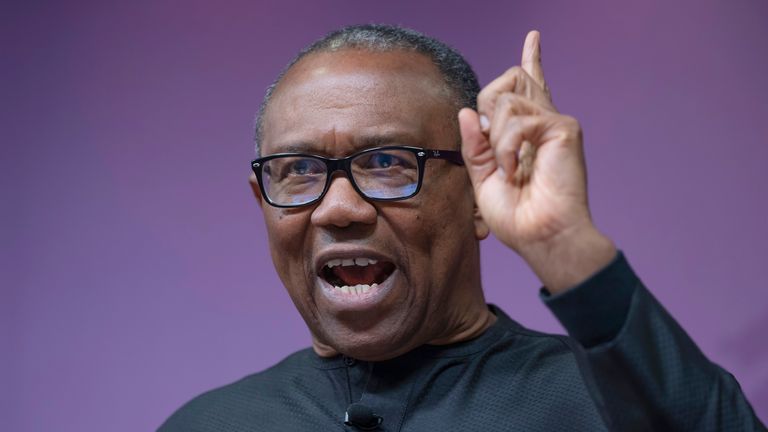
Mr Abubakar has framed the 2027 election in stark terms, warning that failure to dislodge the APC would risk prolonging economic decline and governance failures. Meanwhile, figures such as Peter Obi have attracted considerable support among younger voters, energising a demographic that could prove decisive if mobilised effectively.
There are also signs that the opposition is attempting to reposition itself not merely as a protest movement but as a credible government-in-waiting. Promises of institutional reform, economic stabilisation and a renewed anti-corruption drive form the backbone of its emerging narrative — one designed to contrast sharply with the perceived shortcomings of the incumbent administration.
Yet questions remain. Nigerian elections are rarely straightforward, and the opposition must still translate rhetoric into a coherent policy platform. Internal rivalries, if left unresolved, could yet undermine its prospects.
For voters, the choice in 2027 is likely to be framed in familiar but pressing terms: continuity versus change, experience versus renewal, and stability versus reform. With the clock ticking — 275 days and counting — Nigeria once again finds itself at a pivotal juncture.
The outcome will not only shape the country’s domestic trajectory but also signal, to a watching world, the strength and durability of democratic politics in West Africa.


Leave a Reply